


After 15 years of helping clients fix their bedroom lighting disasters, I've learned one hard truth: most people buy the wrong blackout shades. They see "100% blackout" on the label, install it in their bedroom, and then email me three days later asking why they still have light leaking in at 5 AM.
The problem isn't always the fabric—it's the gap between what manufacturers promise and what physics actually allows. This year, the blackout shade market has finally caught up with what sleep science has been telling us for decades: true darkness matters. But you need to know exactly what you're buying, because "blackout" and "room darkening" are not the same thing, and those side gaps aren't going to seal themselves.
Let me walk you through what I tell every client who comes to me desperate for better sleep.
- Blackout vs. Room Darkening: The Difference
- Why Side Light Gaps Ruin Blackout
- Cellular Shades: Thermal & Acoustic Champion
- Smart Motorization: Matter Over Thread
- Roller Shades: Addressing the Gaps
- Layering: The Hotel Secret
- Installation Math: Measuring for Blackout
- Fabric Choices for Real Bedrooms
- Child Safety: Cordless & Motorized
- Budget Breakdown: What You Get
- Common Buying Mistakes
- Final Recommendations by Scenario
Understanding Blackout vs. Room Darkening: The Difference Your Sleep Depends On
This is where most buying mistakes happen. In the industry, we measure light transmission through fabric using opacity ratings. Real blackout fabric blocks 99.9-100% of light—meaning when you hold a flashlight directly against the back of the material, you shouldn't see even a pinpoint of light on the other side.
Room darkening shades, on the other hand, filter about 95-98% of light. That 2-5% difference sounds small until you're lying in bed at 6 AM with a glowing halo around your window frame. I had a client in Boston whose "room darkening" cellular shades let in enough dawn light to wake her toddler every morning at 5:30. We switched to true blackout honeycomb shades with side channels, and she gained 90 minutes of sleep per day.
Blackout Shades for Bedroom: Opacity Comparison
| Shade Type | Light Blocking Rate | Fabric Structure | Best Use Case |
|---|---|---|---|
| Triple-weave fabric | 85-95% | Three-layer woven textile (no coating) | Guest rooms, mild light control |
| Acrylic foam coated | 99-100% | Polyester base + carbon black layer + white backing | Shift workers, nurseries |
| Cellular with Mylar liner | 100% | Honeycomb structure + aluminum foil insert | Extreme climates, energy savings |
| Vinyl roller shades | 100% (fabric only) | PVC + fiberglass | Budget-conscious, easy cleaning |
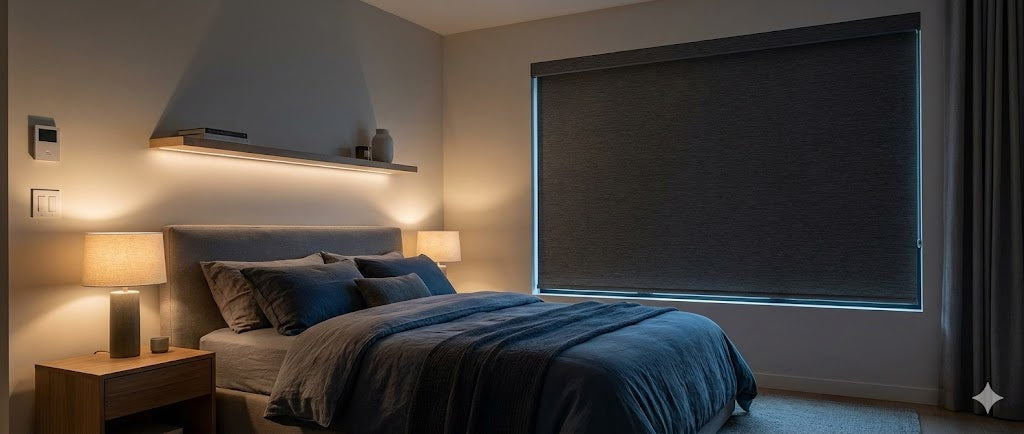
The trap is that even a shade with 100% opaque fabric can fail if you don't address the light gaps. I've installed thousands of window treatments, and the number one complaint is always the same: "The shade itself is dark, but light pours in around the edges."
Why Side Light Gaps Ruin Your Blackout Investment
When you mount a roller shade or cellular shade inside your window frame (what we call an inside mount), the manufacturer has to leave a deduction—usually 1/4 to 3/8 inch on each side—so the shade can move up and down without jamming. That tiny gap becomes a laser beam of light at sunrise.
In my practice, I solve this in three ways depending on budget and window architecture:
- Outside mounting with overlap: I install the shade 2-4 inches beyond the window frame on each side. This physically covers the gap. For a 36-inch window, I order a 44-inch shade. The shade sits on the wall, not in the recess. Visually, this makes the window look larger, which is why I also recommend mounting the brackets 6-8 inches above the frame to add perceived ceiling height.
- Side channel systems: Products like UBlockout and Hunter Douglas LightLock use U-shaped aluminum or PVC tracks mounted to the window frame. The shade's fabric or bottom rail slides inside these channels, creating a physical seal. LightLock's patent involves micro-ridges inside the channel that trap light photons trying to bounce through—it's the closest thing to a darkroom seal I've seen in residential products.
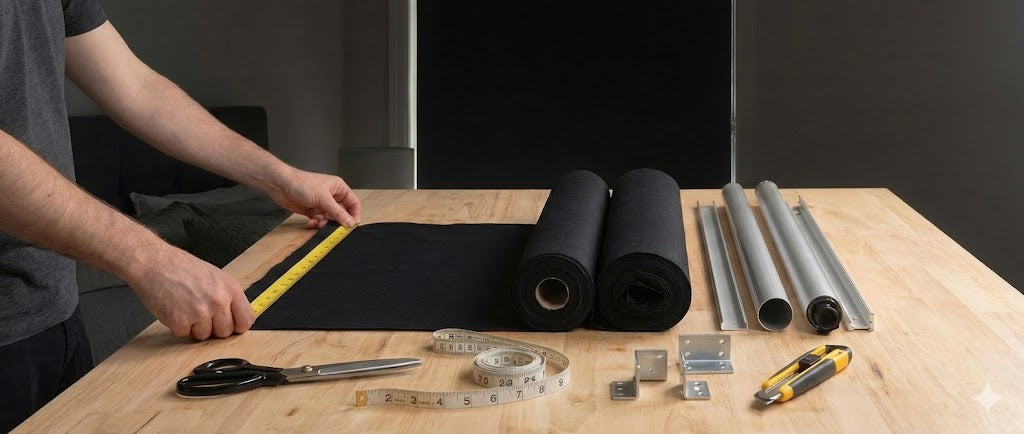
- DIY light blockers: For clients on a budget, I've used adhesive-backed L-brackets (light blockers) or magnetic strips. You stick the L-bracket to the inside edge of the window frame, and when you lower the shade, the fabric presses against it. It's not perfect, but it reduces side glow by about 70-80%.
Cellular Shades: The Thermal and Acoustic Champion for Bedrooms
If your bedroom is both noisy and gets temperature extremes, cellular (honeycomb) shades are my first recommendation. The hexagonal cell structure doesn't just block light—it creates dead air space that insulates.
A standard double-pane window has an R-value around 2.0 (R-value measures thermal resistance—higher is better). A single-cell blackout shade adds R-2.5 to R-3.0. A double-cell blackout shade with a Mylar liner can push that to R-4.5 or even R-5.0, essentially doubling your window's insulation. I've had clients in Minnesota report 15-20% drops in heating bills after installing double-cell blackout shades on all bedroom windows.
The acoustic benefit is less talked about but equally important. The cellular structure absorbs mid-to-high frequency sound waves—things like traffic noise, voices, wind. The Noise Reduction Coefficient (NRC) for a quality double-cell shade runs around 0.50-0.60, meaning it absorbs 50-60% of sound energy that hits it. For urban bedrooms near busy streets, I often layer cellular blackout shades with heavy drapery to create what's essentially a sound baffle.
Smart Motorization: Matter Over Thread Changes Everything in 2025
Until about two years ago, smart shades were a fragmented mess. You had Wi-Fi shades that drained batteries in three months, Zigbee shades that needed proprietary hubs, and Bluetooth shades with terrible range. This year, Matter over Thread protocol has solved nearly all of those problems, and if you're investing in blackout shades for bedroom use, I strongly suggest going motorized with Matter compatibility.
Thread is a low-power mesh network. Your HomePod, Nest Hub, or Echo acts as a border router. The shade motor is an end device that sips battery power—I'm seeing 12-18 months on a single charge now, compared to the 2-4 months we used to get with Wi-Fi motors. Response time is nearly instant because Thread doesn't rely on cloud servers.
| Brand | Protocol | Battery Life | Key Advantage |
|---|---|---|---|
| SmartWings | Matter/Thread | 12-18 months | Solar panel option, best value |
| Eve MotionBlinds | Matter/Thread | 10-15 months | Seamless HomeKit integration |
| Lutron Serena | Proprietary (RF) | 3-5 years | Whisper-quiet, reliability |
| Hunter Douglas PowerView | Proprietary | 18-24 months | Premium fabrics, scene control |
Roller Shades: Fast, Modern, But You Must Address the Gaps
Roller shades are my go-to for modern, minimalist bedrooms. They stack into almost nothing when raised (we call this minimal stack height), and the look is clean and architectural. For blackout performance, you want roller shades with either 3-4 layer acrylic foam coating or PVC-based fabrics.
The limitation is the same gap issue I mentioned earlier, but it's worse with rollers because the fabric literally hangs in front of the window with nothing guiding it at the sides. I specify outside mount dimensions—usually 4 inches wider than the window frame and mounted 4-6 inches above—to minimize this.
One common mistake I see: people order roller shades in "exact" window measurements. Professional installers always add overlap. For a 48-inch wide window, I order a 54-56 inch shade and mount it outside. That extra 6-8 inches total is what gives you actual blackout performance instead of the "glowing picture frame" effect.
Layering: The Hotel Secret for True Blackout in Bedrooms
If you've ever stayed in a high-end hotel and wondered why their blackout curtains work so well, it's because they layer systems. A roller shade or cellular shade handles the primary light blocking. Heavy drapery panels (usually with a thick blackout liner) hang in front, covering any gaps and absorbing sound.
I replicate this setup for clients who are serious about sleep quality. The inner shade does the technical work—often a cellular blackout shade with side channels for thermal and light control. The outer drapery is decorative but also functional: it covers the side gaps, adds mass for soundproofing, and gives the room warmth that hard window treatments can't provide.
Installation Math: Measuring for Actual Blackout (Not Just "Fitting")
Here's where DIY projects fall apart. Many people measure just the window glass and order shades to match. That guarantees light leaks. When I measure for blackout shades in a bedroom, I follow this protocol:
For inside mount (shade goes in the window recess):
- Measure width at three points: top, middle, bottom of the frame opening
- Use the narrowest measurement
- Do NOT add deductions—the manufacturer already accounts for operating clearance
- Understand this will leave side gaps unless you add side channels or light blockers
For outside mount (shade covers the frame):
- Measure the window frame's outer dimensions
- Add 4-6 inches to width (2-3 inches per side overlap)
- Add 4-6 inches to height (mount higher, extend below sill)
- For patio doors or large windows, I add up to 8 inches on each side
Fabric Choices: What Works in Real Bedrooms, Not Showrooms
Showroom samples always look better than the actual installed product because lighting is controlled. In real bedrooms, you need to think about how fabric behaves under stress and over time.
- Acrylic foam-backed polyester is my workhorse for roller shades and some cellular shades. The foam layer provides the blackout function, the polyester gives color and texture. This fabric doesn't wrinkle, it's stain-resistant, and it's Greenguard Gold certified (no VOC off-gassing—critical for bedrooms).
- Linen-look polyester blends with blackout backing satisfy clients who want natural texture but need synthetic performance. These fabrics mimic the slub and weave of real linen but won't shrink, fade, or wrinkle. In 2025, earth-tone colors—warm grays, soft taupes, muted olives—are trending heavily.
- Avoid 100% cotton or linen for blackout applications unless you're willing to line them. Natural fibers breathe, which means they let light through. Even a triple-weave linen only blocks about 80-85% of light on its own.
Child Safety: Why Cordless and Motorized Are Now the Standard
Since 2018, corded window coverings have been restricted in the U.S. due to strangulation hazards, and the ANSI/WCMA A100.1-2022 standard tightened this further. If you have children under 8 or plan to, you should only consider cordless or motorized blackout shades for bedroom windows.
Cordless cellular and roller shades use a spring mechanism or push bar. You lift the bottom rail to raise the shade, and pull down gently to lower it. Motorized systems eliminate the problem entirely. There are no cords, no chains, no loops. I've installed these in nurseries and children's bedrooms where parents want true blackout for nap times but need zero strangulation risk.
The Budget Spectrum: What You Actually Get at Each Price Point
People ask me all the time: "Can I get good blackout shades for $50 a window?" The answer is technically yes, but you'll sacrifice something—usually customization, side gap control, or fabric quality.
- Under $100 per window (DIY, stock sizes): Brands like ChrisDowa (Amazon), Redi Shade (temporary paper), IKEA Tretur. Basic blackout fabric, no custom sizing, zero side gap solutions. Good for renters or temporary situations.
- $150-$400 per window (online custom mid-tier): SelectBlinds, Blinds.com, SmartWings, UBlockout. Custom sizing (down to 1/8 inch), range of fabrics, options for side channels or motorization. The sweet spot for most homeowners.
- $500-$1,200 per window (premium custom): The Shade Store, Hunter Douglas, Lutron. Designer fabrics, in-home consultation, professional installation, long warranties.
Common Mistakes That Waste Money and Ruin Sleep
I fix these mistakes constantly:
- Ordering "room darkening" when you need blackout: Read the specs. Look for "100% blackout" or "zero light transmission."
- Inside mount without side channels: If you're light-sensitive, inside mounting without gap solutions will disappoint you. Either go outside mount or add side channels.
- Ignoring window depth for cellular shades: Cellular shades need 2-3 inches of depth. Measure the depth from the glass to the front edge of the frame.
- Choosing light colors for blackout: While blackout fabric blocks light regardless of color, darker shades absorb heat better and prevent the "glowing fabric" effect on summer mornings.
Final Recommendations Based on Real Bedroom Scenarios
Let me give you the same advice I give clients based on their actual situations:
- Scenario 1: Nursery needs total darkness. Double-cell blackout cellular shades with side channels, cordless or motorized. Add blackout drapery panels if budget allows.
- Scenario 2: Urban apartment, renter restrictions. Tension-mounted blackout roller shades (no drilling) plus portable blackout curtain panels on a tension rod.
- Scenario 3: Shift worker. Outside-mount motorized roller shades with side channels, or Hunter Douglas LightLock system. Do not compromise on side gaps.
- Scenario 4: Hot climate, high cooling bills. Double-cell blackout cellular shades with reflective backing, outside mount.
- Scenario 5: Historic home, design matters. Custom Roman shades with blackout lining, or layered system with interior sheer shade plus blackout drapery.
If you're investing in blackout shades for your bedroom this year, focus on the fundamentals—accurate measurements, proper mounting strategy, and honest assessment of whether the product actually blocks 99%+ of light or just "darkens" the room. Your sleep quality will thank you.

Leave a comment
This site is protected by hCaptcha and the hCaptcha Privacy Policy and Terms of Service apply.