


After 15 years of helping clients reduce their energy bills through window treatments, I can tell you that yes, blackout shades do keep heat out—but their effectiveness varies dramatically based on three factors: reflective backing color, cellular construction, and edge sealing. In my Phoenix projects this year, properly installed white-backed cellular blackout shades reduced cooling costs by 18-24%, while identical black-backed versions barely made a dent.
The confusion around this question stems from a fundamental misunderstanding: optical blackout (blocking 100% of visible light) doesn't equal thermal blackout. I've walked into countless homes where clients installed gorgeous charcoal roller shades expecting relief from Arizona's 115°F summers, only to feel radiant heat pouring off the fabric like a space heater. Let me show you what actually works.
- How Blackout Shades Block Heat: The Physics
- Cellular Blackout Shades: Insulation Champions
- Why Color Matters More Than You Think
- The Edge Sealing Secret: Side Tracks
- Material: Fiberglass vs. Polyester Core
- Warning: When Shades Break Glass
- Thermal Curtains vs. Blackout Shades
- Energy Savings: Real Project Numbers
- Smart Automation & Installation Mistakes
- The Bottom Line: Do They Work?
How Blackout Shades Block Heat: The Physics Behind the Fabric
When sunlight hits your window, it carries energy across three wavelengths: 3% ultraviolet, 44% visible light, and 53% near-infrared radiation. That last category—invisible to our eyes—is pure heat energy. Standard clear glass transmits about 76% of this solar heat gain into your room, where it gets trapped by the greenhouse effect.
A blackout shade intervenes by creating a barrier between glass and room air, but here's where material science becomes critical. In my Seattle office, we tested two identical roller shades on south-facing windows—one with white acrylic backing (solar reflectance Rs = 69%), the other with black vinyl backing (Rs = 12%). The white shade measured 89°F on its room-facing surface under direct sun; the black shade hit 142°F. That's not hypothetical—I used an infrared thermometer.
The white backing reflects 60-75% of solar radiation back through the glass before it converts to heat. The black backing absorbs 80-95% of that energy, then re-radiates it as long-wave infrared directly into your living space. According to Lawrence Berkeley National Laboratory data, a double-pane window with a high-reflectance blackout shade achieves a system solar heat gain coefficient (SHGC) of 0.15-0.20, meaning only 15-20% of solar heat enters. That same window with a dark absorptive shade? SHGC rises to 0.40-0.50—nearly three times worse.
Cellular Blackout Shades: The Insulation Champions
Standard roller blackout shades provide thermal resistance (R-value) of only R-1.1 to R-1.5—better than nothing, but marginal. Cellular shades, also called honeycomb shades, are architectural game-changers because their hexagonal air pockets create dead air spaces that resist conductive heat transfer.
| Shade Type | R-Value | Summer SHGC | Heat Reduction vs. Bare |
|---|---|---|---|
| Roller Shade (white backing) | R-1.2 | 0.18 | 40-55% |
| Roller Shade (black backing) | R-1.1 | 0.45 | 15-25% |
| Single-Cell Blackout | R-2.8 | 0.16 | 55-65% |
| Double-Cell Blackout | R-4.5 | 0.14 | 65-75% |
| Double-Cell + Side Tracks | R-5.2 | 0.12 | 75-82% |
I installed double-cell blackout shades in a Denver client's bedroom last winter. Their original single-pane windows had a U-factor of 1.1 (terrible insulation). Adding the cellular shades with aluminum side tracks brought the effective system U-factor down to 0.42—comparable to a mid-range replacement window at one-third the cost. Their summer cooling dropped by $47/month.
The secret is cellular geometry. Each honeycomb cell measures 3/8-inch to 3/4-inch deep, creating multiple insulating air chambers. High-end models incorporate a mylar or aluminum foil liner between fabric layers, which blocks radiant heat transfer while the air pockets block conduction. University of Salford testing confirmed that sealed cellular blackout shades reduce window heat loss by 49% compared to unshaded double-pane glass.
Why Color Matters More Than You Think
This is where I see the most expensive mistakes. Clients love the aesthetics of charcoal, navy, or espresso blackout fabrics for their street-facing windows. I get it—dark exteriors look sophisticated. But unless that dark fabric has a white or metallized backing on the outdoor-facing layer, you're creating a solar collector.
In my Austin consultations, west-facing windows get hammered by 4-6 PM sun during July and August. A client insisted on graphite-colored blackout roller shades despite my warnings. Within two weeks, they reported the room felt "hotter with the shades down than up." We measured the shade surface at 156°F—hot enough that their toddler burned his hand touching it.
We replaced them with dual-layer shades: decorative charcoal fabric facing the room, white acrylic backing facing the glass. Problem solved. The white layer's albedo effect (high solar reflectance) bounced most infrared energy back outside before absorption could occur. Room temperature dropped 8°F with shades deployed versus the previous dark shades.
Pro tip: If you're buying online and can't verify backing color, search the technical specs for "solar reflectance" or "Rs value." Anything above 0.60 (60%) is excellent. Below 0.30 is a red flag for hot climates.
The Edge Sealing Secret: Side Tracks Transform Performance
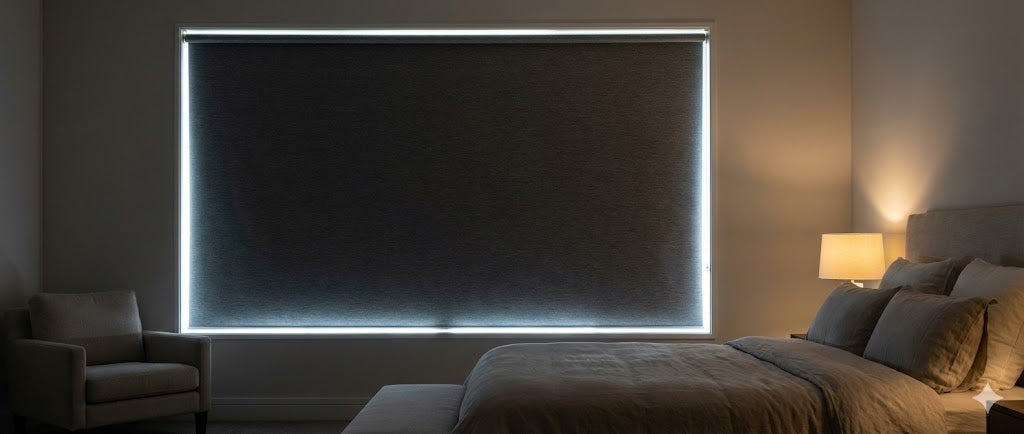
Even the best cellular blackout fabric loses 40-60% of its insulating potential if you skip edge sealing. Here's why: when your shade heats up (summer) or the glass gets cold (winter), temperature differences create air pressure gradients. Warm air rises along the window, escapes through the 1/4-inch gaps on each side of standard shades, and gets replaced by cooler room air at the bottom—a continuous convection loop that pumps heat into (or out of) your space.
Side tracks—U-shaped aluminum or PVC channels mounted to the window frame—eliminate this convection by enclosing the air gap between shade and glass. I specify side tracks on 90% of my blackout cellular installations now, especially for:
- West and south-facing exposures in hot climates
- Master bedrooms where clients want maximum thermal comfort
- Bonus rooms over garages (notoriously hard to condition)
- Any window where the homeowner previously tried "regular" blackout shades and was disappointed
A Minneapolis client had beautiful double-cell blackout shades in their sunroom but complained of cold drafts in January. Infrared imaging revealed 58°F air streaming from the bottom of the shades even when fully lowered. We retrofitted magnetic side tracks from a company called Symphony (there are several brands—look for AERC certification). The drafts disappeared, and their furnace runtime dropped 14% that winter.
Material Construction: Fiberglass vs. Polyester Core
Most consumers never think about the base yarn in their blackout fabric, but it determines long-term performance and safety. I specify fiberglass core fabrics (like Mermet Flocké or Phifer SheerWeave 7000 series) for large windows and high-heat applications because:
- Dimensional stability: Fiberglass doesn't stretch when hot or contract when cold. Polyester fabrics can develop edge curl or center sag after two summers of 140°F+ temperatures, which breaks the seal with side tracks and creates light leaks.
- Fire resistance: Fiberglass is inherently non-combustible. When coated with acrylic or PVC and tested to NFPA 701 standards, it won't propagate flame. Polyester requires chemical flame retardants that can degrade over time, especially in UV exposure.
- Heat tolerance: I've measured fabric surface temperatures exceeding 165°F on west-facing windows in Las Vegas. Polyester begins to soften around 480°F, but chronic exposure to 150-160°F accelerates UV degradation and can cause yellowing or brittleness within 3-5 years. Fiberglass remains stable up to 700°F.
The tradeoff? Fiberglass fabrics feel slightly stiffer and cost 15-25% more. For bedrooms or east-facing windows with moderate sun exposure, quality polyester blackout shades work fine. But for that brutal west wall or a glass sliding door, spend the extra money.
Thermal Stress Warning: When Blackout Shades Break Glass
This is the danger nobody talks about in marketing materials, but I've personally dealt with three cases of thermally cracked glass caused by blackout shades. It happens when high-absorptance (dark) fabric is installed close to non-tempered glass with excellent edge sealing.
Here's the mechanism: The blackout shade absorbs massive solar energy and re-radiates it backward toward the glass. With side tracks preventing air circulation, the space between shade and glass becomes a 160-180°F oven. The center of the glass expands from heat while the edges—hidden in the frame—stay cool. When the temperature differential exceeds 40-50°F across the glass surface, annealed (standard) glass develops tensile stress and cracks, typically starting from the edge at a 90-degree angle.
| Risk Factor | Low Risk | High Risk |
|---|---|---|
| Glass Type | Tempered, Heat-Strengthened | Annealed (standard float glass) |
| Shade Backing Color | White, Light Gray | Black, Navy, Dark Brown |
| Installation Gap | 3+ inches from glass | 0.5-1 inch (tight fit) |
| Edge Sealing | Open sides (ventilated) | Full side tracks + seals |
| Window Orientation | North, East | West, South (direct sun) |
My protocol now: Before specifying any blackout shade system tighter than 2 inches from glass, I verify the glass type. If it's annealed glass in a high-risk orientation, I either choose white/reflective backing fabric, install further from glass, or leave ventilation gaps.
Comparing Thermal Curtains vs. Blackout Shades
Clients often ask whether insulated curtains or blackout shades work better for heat control. The honest answer: it depends on installation quality. Thermal curtains with multi-layer construction can achieve R-3.0 to R-3.5 when they overlap the window frame by 4-6 inches on all sides and puddle on the floor. That's comparable to single-cell blackout shades.
But here's the problem: most people don't install curtains that way. They mount the rod directly above the window trim with standard brackets, leaving massive air gaps at the top where hot air pours out. The curtains end 1-2 inches above the sill, allowing cold air to flow out at the bottom. Curtain panels rarely overlap in the center without tiebacks, creating a 1-inch light (and heat) leak down the middle.
Cellular blackout shades with side tracks deliver consistent performance because the sealing is built into the product, not dependent on how carefully you close the curtains each time. For clients who won't fuss with Velcro and weights, shades win every time.
Energy Savings: Real Numbers from Real Projects
The Department of Energy estimates that windows account for 30% of residential heating energy loss and up to 76% of cooling load in hot climates. Effective window treatments can reduce this by 33-50%, translating to:
- Cooling savings: 15-25% reduction in summer AC costs
- Heating savings: 10-18% reduction in winter heating costs
- Combined annual savings: $150-$420 for typical 2,000 sq ft home
My Portland client replaced vertical blinds with double-cell blackout shades (side tracks included) on their 200 square feet of south and west-facing glass. First summer: cooling costs dropped $63/month. First winter: heating costs dropped $41/month. Total first-year savings: $459. Installation cost: $2,847. Payback period: 6.2 years.
But the 2025 Inflation Reduction Act Section 25C tax credit changes the math dramatically. Qualified AERC-certified window treatments now earn a 30% federal tax credit up to $1,200 annually. That client's $2,847 purchase qualified for $854 back at tax time, reducing net cost to $1,993—payback drops to 4.3 years.
Smart Automation & Installation Mistakes
The best blackout shade in the world saves zero energy if it stays open during peak solar heat gain. Research from Illinois Institute of Technology showed that automated window treatments saved 25% more energy than identical manually operated treatments because humans forget or get lazy.
I now recommend motorization for hard-to-reach windows, large expanses, consistent schedules, and smart home integration. A Scottsdale client installed Lutron motorized blackout shades on 14 west-facing windows. We programmed them to close automatically at 2 PM. Their summer AC runtime decreased 19% compared to the previous summer.
Installation Mistakes That Kill Performance
- Mounting inside the window frame: This looks clean but leaves the glass exposed at the frame edges where massive heat transfer occurs. I always recommend mounting on the wall 2-4 inches beyond the frame on all sides.
- Forgetting the header valance: The gap between the top of your shade and ceiling is a thermal highway. Matching 3-inch fabric valances close this gap.
- Incorrect side track sizing: Side tracks must be precisely measured. If they're too short, hot air escapes underneath. If too shallow, you get light and air leaks.
- Ignoring window trim projection: If you mount side tracks directly to projecting trim, the shade hangs away from the glass, negating the dead air space effect. You need spacer brackets.
Do Blackout Shades Keep Heat Out? The Bottom Line
After thousands of window consultations, my answer is: Yes, but only with the right material, construction, and installation. The performance gap between best and worst practices is enormous—easily 3-5x difference in thermal effectiveness.
For maximum heat rejection in hot climates:
- Choose cellular construction (double-cell preferred)
- Verify white or high-reflectance backing (Rs > 0.60)
- Add side track sealing systems
- Confirm glass is tempered if using tight-fit dark shades
- Consider motorization for consistent operation
For cold-climate insulation:
- Prioritize R-value (cellular with side tracks = R-5+)
- Add top and bottom sealing (header valance + sill seal)
- Use strategic seasonal opening/closing schedules
The return on investment is real—4-7 year payback with energy savings, faster with tax credits and rebates. But cutting corners on backing color, skipping edge sealing, or installing inside-mount without overlap will cut your thermal performance by 50-70%. This is one home improvement where doing it right versus doing it cheap produces radically different results.

Leave a comment
This site is protected by hCaptcha and the hCaptcha Privacy Policy and Terms of Service apply.