


After 15 years of designing window treatments for homes across the Pacific Northwest—where early summer sunrises can flood bedrooms at 5 a.m.—I've learned that the question "What is the best roller shade for blackout?" rarely has a simple answer. The reality is that most homeowners aren't just asking about fabric opacity. They're asking why light still seeps around the edges even after spending $300 on a so-called "blackout" shade.
The truth is that achieving true blackout—the kind of darkness where you can't see your hand in front of your face—requires understanding a fundamental engineering problem: the gap between your shade and the window frame. In 2026, the market has split into distinct solutions based on whether you prioritize absolute light control, whisper-quiet motors, or budget-friendly DIY installation.
- Why Standard "Blackout" Shades Still Let Light In
- The Side Channel Solution: Engineering vs. Marketing
- Comparing Blackout Performance Ratings
- Motor Noise: The Overlooked Factor
- Battery Life & Maintenance Cost
- Fabric Chemistry & Air Quality
- Thermal Performance & Insulation
- Inside vs. Outside Mount for Blackout
- Smart Home: Matter vs. Proprietary (2025)
- My Top Recommendations by Use Case
- Common Mistakes & Maintenance
Why Standard "Blackout" Shades Still Let Light In
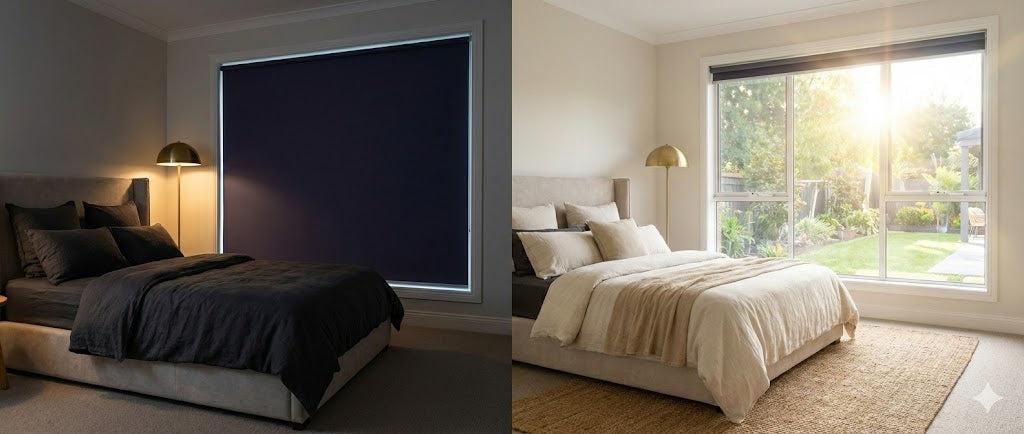
The term "blackout" on most product labels refers only to the fabric's opacity—not the complete system's performance. I've measured this gap in dozens of client installations: when you mount a roller shade inside the window frame (the most common approach), mechanical clearance requirements create a 1/2-inch to 1-inch light gap on each side.
Here's why this happens: The fabric must be narrower than the mounting brackets to avoid friction during rolling. If you choose a continuous cord loop system, the clutch mechanism on the control side requires approximately 3/4 to 1 inch of clearance. Cordless spring systems need 5/8 to 3/4 inch on both sides to house the internal spring tension components. Even motorized systems—despite having compact tubular motors—typically reserve 1/2 to 3/4 inch for signal reception and heat dissipation.
This isn't a defect. It's physics. And it's the reason why a Portland client once told me her "100% blackout" shade from a big-box retailer still created what she called "the glowing frame effect" every morning.
The Side Channel Solution: Engineering vs. Marketing
In my consulting practice, I divide blackout roller shades into two categories: fabric-only systems and complete light-sealing systems.
Fabric-only systems use opaque materials (typically vinyl-coated polyester or PVC-laminated fiberglass) but rely on standard inside-mount installation. These deliver approximately 80-85% light reduction—excellent for general bedroom use, but insufficient if you work night shifts or suffer from light-triggered migraines.
Complete light-sealing systems add side channels (also called side tracks or U-channels) that physically guide the fabric edges, eliminating the gap. The most sophisticated example I've specified is Hunter Douglas's LightLock™ technology, which uses micro-ridged channels to trap and absorb stray photons through repeated internal reflection. In laboratory conditions, this system achieves 99.9% light blockage—the closest thing to architectural blackout curtains in a roller shade format.
However, LightLock is only available in their Duette honeycomb shade line, not roller shades. For roller shade users, the practical alternatives are:
- Frame-integrated systems like UBlockout, which encase the entire shade in a custom aluminum frame (top box depth up to 2.5 inches, side channels 1.375 inches deep)
- Retrofitted side blockers—adhesive or magnetic PVC strips you attach after installation
- Outside mount with overlap—extending the shade fabric 3-4 inches beyond the frame on all sides
Comparing Blackout Performance: What the Specs Actually Mean
When evaluating roller shades, manufacturers use confusing terminology. Let me translate the most common ratings based on fabric samples I've tested in real installations:
| Marketing Term | Actual Light Blockage | Visible Light Transmission (VLT) | Real-World Experience |
|---|---|---|---|
| Light Filtering | 25-50% | 50-75% | Reduces glare but you can still read clearly |
| Room Darkening | 75-85% | 15-25% | Suitable for daytime napping; streetlights visible at night |
| Blackout (fabric only) | 95-99% | 1-5% | Dark enough for sleep but side gaps glow |
| Total Blackout (with side channels) | 99.9% | <0.1% | Cannot see hand in front of face |
The difference between 95% and 99.9% sounds trivial on paper, but your eyes perceive brightness logarithmically. That remaining 5% creates what I call the "picture frame effect"—a glowing outline that defeats the purpose of blackout shades for light-sensitive sleepers.
Motor Noise: The Overlooked Blackout Factor
If you're considering motorized blackout shades—and in 2025, nearly 40% of my clients choose automation for bedroom shades—motor noise becomes as critical as light blockage. There's nothing more ironic than a shade that creates perfect darkness but wakes you up with grinding gears.
I categorize motor performance into three tiers based on decibel measurements taken 3 feet from the shade:
- Whisper-tier motors (under 35 dBA): Lutron's Serena shades with Triathlon motors represent the engineering pinnacle here. Using proprietary Quiet Drive technology with precision-machined gears and DC brushless motors, they operate quieter than a typical refrigerator. In a Seattle master bedroom project, I installed eight of these across a wall of windows—when they open at sunrise, the homeowner doesn't wake until her alarm. The catch? Lutron requires their proprietary Caséta hub and uses a 434 MHz RF protocol (Clear Connect) rather than standard Wi-Fi, which means rock-solid reliability but limited cross-platform integration.
- Standard-quiet motors (38-45 dBA): Brands like SmartWings (with Matter-over-Thread motors) and Somfy's Sonesse line fall here. You'll hear a low hum—similar to a bathroom exhaust fan—but it's not jarring. These work well in guest rooms or home offices where occasional motor noise is acceptable. SmartWings has impressed me in 2025 with their custom-sized shades (precise to 1/8 inch) at one-third the cost of Lutron, though motor longevity remains unproven compared to Somfy's 15-year track record.
- Budget-tier motors (over 45 dBA): IKEA's Fyrtur and generic Tuya-based motors produce audible gear grinding at 50-55 dBA. One client described her IKEA shades as sounding "like a coffee grinder." For blackout purposes in a bedroom, I cannot recommend these unless noise isn't a concern.
Battery Life and the Hidden Maintenance Cost
Here's a detail most reviews ignore: motorized blackout shades require power, and maintenance frequency varies wildly.
Lutron's Triathlon motors run on standard D-cell alkaline batteries with an astonishing 3-5 year lifespan. This isn't marketing exaggeration—I have installations from 2020 still running on original batteries. The secret is their power management system, which draws current only during motion and enters true sleep mode otherwise. Alkaline batteries also have minimal self-discharge, unlike lithium-ion.
Most competitors use built-in rechargeable lithium batteries with 6-12 month lifespans. SmartWings offers a solar panel accessory, but in my Seattle projects, north-facing windows in winter don't generate enough charge—clients end up climbing ladders with USB-C cables every few months. If you have multiple bedroom windows, this becomes a genuine nuisance.
The only exception: if your home has low-voltage wiring from a previous automation system, hardwired motors (like those from QMotion or Lutron's Palladiom line) eliminate battery concerns entirely. I specify these for whole-home builds but rarely for retrofits due to installation complexity.
Fabric Chemistry and Indoor Air Quality
In 2025, I'm seeing more clients ask about the chemical composition of blackout fabrics, especially for nurseries. The majority of blackout roller shades use PVC (polyvinyl chloride) coating to achieve opacity. While effective, PVC can off-gas volatile organic compounds (VOCs), particularly when new or exposed to heat from direct sunlight.
For health-conscious clients, I recommend fabrics with Greenguard Gold certification, which limits VOC emissions to levels safe for schools and hospitals. Lutron's blackout fabrics meet this standard. Hunter Douglas publishes air quality test results for their materials. Budget brands rarely certify their fabrics—I've encountered shades from Amazon sellers that had a chemical smell lasting weeks.
The alternative is PVC-free blackout fabric, typically using acrylic foam lamination. SmartWings offers a 100% blackout linen option with acrylic backing that's both effective and breathable. IKEA's Tredansen honeycomb shades use 100% polyester with polyethylene plastic, complying with strict EU REACH regulations (no PVC, no phthalates). The trade-off? PVC-free fabrics tend to be slightly less opaque and may require side channels to achieve true blackout.
Thermal Performance: Blackout as Insulation
An underrated benefit of blackout roller shades is their thermal insulation value. The same dense fabric that blocks light also reduces heat transfer. In my energy audits, I've measured temperature differences of 5-8°F at the window surface when blackout shades are closed during summer afternoons.
The key is fabric backing color. White-backed blackout fabrics reflect solar radiation, keeping rooms cooler. Dark-backed fabrics absorb heat, which then radiates inward—creating a "radiator effect" that negates the shade's insulating value. Every quality blackout shade I specify has a white exterior-facing surface, regardless of the interior color the client chooses.
For cold climates, cellular (honeycomb) blackout shades outperform flat roller shades due to trapped air pockets. Hunter Douglas's Duette blackout shades achieve R-values of 4.0 to 5.0 when fully extended—comparable to a double-pane window. However, roller shades have aesthetic advantages (cleaner lines, lower profile when raised) that many clients prefer.
Installation Method: Inside Mount vs. Outside Mount for Blackout
This is where I spend the most time educating clients, because mounting choice determines whether your "blackout" shade actually blocks light.
Inside mount (shade fits within the window frame) is the default for aesthetics—it showcases trim work and maintains clean lines. But as I've explained, mechanical clearances create light gaps. If you choose inside mount for blackout shades, you must add side light blockers. I use products like Sleepy Time Tracks (magnetic PVC strips) or adhesive-backed L-channels. These add $30-60 per window and 30 minutes of DIY installation time, but they're essential.
The installation trick I teach clients: clean the window frame with isopropyl alcohol before applying adhesive blockers, and use a level to ensure the strips are perfectly vertical. Any gaps or misalignment will create light leaks.
Outside mount (shade covers the entire frame plus overlap) physically eliminates side gaps if you spec adequate overlap. I recommend extending the fabric 3-4 inches beyond the frame on both sides and the bottom. The top should have a closed cassette or fascia to block light from above.
The aesthetic compromise is significant—you completely hide the window trim. In a 1920s Craftsman home with original woodwork, this feels like sacrilege. But for a modern condo with flat drywall returns, outside mount with blackout shades looks intentionally minimalist.
Smart Home Integration: Matter vs. Proprietary Protocols in 2025
The smart shade market underwent a major shift in 2024-2025 with the adoption of Matter protocol. For clients building new smart home ecosystems, this matters significantly.
Matter-over-Thread shades (like SmartWings' latest models and Eve MotionBlinds) offer true platform independence. They connect directly to your existing Thread network (via HomePod mini, Eero routers, or Google Nest hubs) without brand-specific bridges. I've found Thread's mesh network architecture more reliable than Zigbee in homes with concrete walls, and battery life is measurably better than Wi-Fi models because Thread is a low-power protocol.
Lutron's proprietary Clear Connect remains my top recommendation for reliability despite requiring their Caséta hub. The 434 MHz frequency avoids Wi-Fi congestion, and I've never experienced a connection dropout in five years of installations. Lutron's scene programming (multiple shades moving in perfect synchronization) is still unmatched—in one project, I aligned six 8-foot-wide shades to descend at identical speeds with less than 3mm variance at the bottom hem.
Bluetooth-only systems (Hunter Douglas PowerView Gen 3) work well for setup but require a hub for remote control and scheduling. The advantage is lower power consumption—Hunter Douglas claims their battery sticks last 12-18 months with typical use.
For blackout applications specifically, I prioritize scheduling capabilities. Automated sunrise opening helps maintain circadian rhythm without manual intervention. If you work night shifts, geofencing can trigger shades to close when you arrive home during daylight hours.
My Top Recommendations by Use Case (2025 Edition)
Based on hundreds of installations, here are my specific recommendations:
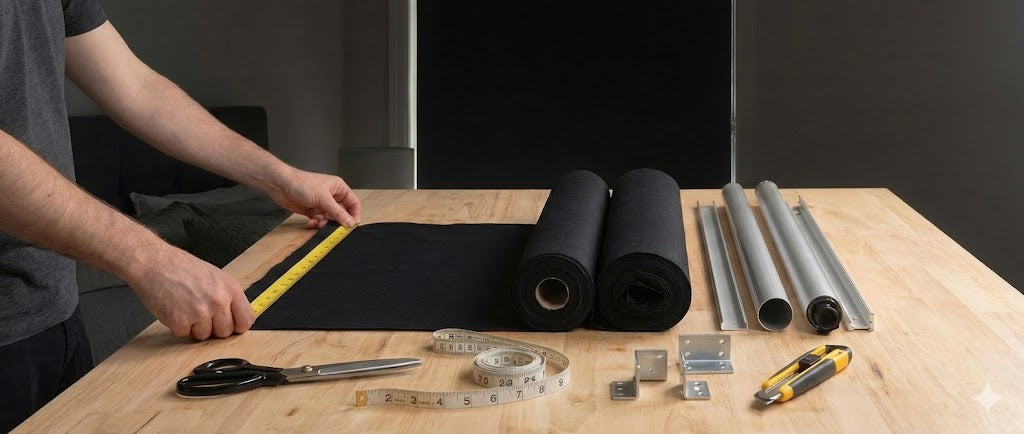
- For absolute blackout (home theater, shift workers, migraine sufferers): UBlockout frame system with their vinyl blackout fabric. Yes, installation is challenging—expect 2-3 hours per window and zero tolerance for measurement errors. But you'll achieve genuine 100% light blockage. I recently specified this for a radiologist who works overnight shifts; she reports total darkness even at noon on sunny days. Cost: approximately $350-450 per window, DIY installation.
- For motorized bedroom shades with minimal maintenance: Lutron Serena roller shades with blackout fabric, inside mount with added magnetic side blockers (Sleepy Time Tracks brand). The combination delivers 95-97% light blockage (sufficient for healthy sleep), 3-5 year battery life, and library-quiet operation. When you add Lutron's sunrise scheduling, you'll wake naturally without alarms. Cost: approximately $600-900 per window installed.
- For budget-conscious smart home users: SmartWings custom blackout roller shades with Matter-over-Thread motors and their proprietary light blocker strips. You'll sacrifice some motor quietness and long-term reliability compared to Lutron, but you get custom sizing (1/8-inch precision), seamless smart home integration, and 90-95% blackout for under $250 per window. I've installed these in rental properties where cost matters more than perfection.
- For DIY-averse clients who want perfection: Full-service installation through The Shade Store or Hunter Douglas Gallery dealers with their premium blackout fabrics and professional installation. You'll pay $800-1,500 per window, but they handle all measurements, provide lifetime warranties, and use commercial-grade hardware. For architects and designers I work with, this is the spec when the client's budget allows.
Common Mistakes That Ruin Blackout Performance
After fixing dozens of failed DIY installations, these are the errors I see repeatedly:
- Measuring only the window opening: You must measure the mounting surface depth (how far the brackets sit from the glass). If you have shallow frames (less than 2 inches deep) and choose inside mount, the shade fabric may touch the glass when rolled down, causing damage and poor operation. I always verify frame depth with a tape measure before specifying inside-mount shades.
- Ignoring window irregularities: Older homes rarely have perfectly square windows. Before ordering custom side-channel systems like UBlockout, I use a carpenter's square to check all four corners. If any corner deviates more than 1/8 inch from 90 degrees, I recommend against rigid aluminum frames—they won't seal properly. Flexible magnetic blockers work better on imperfect frames.
- Choosing blackout shades for west-facing windows without thermal backing: West sun generates intense heat. In my Phoenix projects, I specify dual-layer cellular shades with blackout fabric plus a reflective liner. Single-layer blackout roller shades absorb heat, making the room uncomfortable despite blocking light.
- Forgetting the bottom gap: Most people obsess over side light leaks but ignore the 1/2-inch gap at the bottom where the shade ends above the window sill. For true blackout, the shade must extend below the sill or have a tight seal. Some premium motorized shades include a bottom seal strip; for manual shades, I recommend extending the fabric 2 inches below the sill.
Maintenance and Longevity
Blackout roller shades typically last 7-10 years with proper care, though I've seen Lutron motors still functioning after 15 years. The fabric itself is remarkably durable—the vinyl coating resists UV degradation better than untreated polyester.
For cleaning, I advise clients to vacuum with a brush attachment monthly to prevent dust buildup. For spot cleaning, use a damp microfiber cloth with mild soap (never ammonia-based cleaners, which can damage vinyl coating). Full-immersion washing is not recommended for blackout fabrics—the lamination layers can delaminate.
Motor maintenance is minimal. For battery-powered units, I tell clients to replace batteries on a calendar schedule (not when they die), since exhausted batteries can leak and corrode motor compartments. For Lutron shades, I set an annual calendar reminder to check battery status in their app, though it's rarely needed thanks to their long life.
The most common failure mode I've seen is fabric sagging in very wide shades (over 8 feet). The weight of vinyl-backed blackout fabric can stretch over time, especially in high-heat environments. For spans over 6 feet, I specify reinforced tubes (1.5-inch diameter minimum) or recommend splitting into multiple shades.
The Real Answer to "What's Best"
After 15 years and hundreds of installations, I've learned that the "best" blackout roller shade isn't a single product—it's a system designed for your specific window conditions, budget, and sensitivity to light and noise.
If you demand absolute darkness and have the patience for precision installation, frame-integrated systems like UBlockout deliver unmatched performance. If you value automation, longevity, and whisper-quiet operation with very good (but not perfect) light blockage, Lutron Serena with added side blockers is the gold standard. And if you're building a smart home on a reasonable budget, SmartWings' Matter-enabled custom shades represent the best value in 2025.
The critical insight: don't evaluate blackout shades by fabric alone. The mounting method, side gap treatment, and motor quality (if motorized) matter as much as opacity. And for any roller shade to achieve true blackout, you must address the physical gap between fabric and frame—whether through integrated channels, retrofitted blockers, or outside mount with generous overlap.
In my practice, I now start every blackout consultation by showing clients photos of that glowing "picture frame" effect from standard inside-mount shades. Once they see the problem, the solution—and the justification for investing in proper side channel systems—becomes obvious.

Leave a comment
This site is protected by hCaptcha and the hCaptcha Privacy Policy and Terms of Service apply.